- Negative Bewertungen
- Google Bewertungen
- Reputation
- Bewertungen beantworten
Negative Google reviews: the guide – reply well, get violations removed
Which negative reviews to answer and which to submit for review: classification, a 48-hour reply template, the no-gos and the checklist for policy violations.

A negative Google review hits almost every business at some point – and almost every owner reacts with anger first. Understandable, but expensive: what you do in the first 48 hours decides whether one review becomes weeks of damage or proof of how professionally you handle criticism.
This guide explains the types of negative reviews, how to reply properly, what you must never do – and which negative Google reviews you can submit for review because they violate the policies.
Sort first: three kinds of negative reviews
Before you do anything, classify the review. Almost every negative Google review falls into one of these three groups:
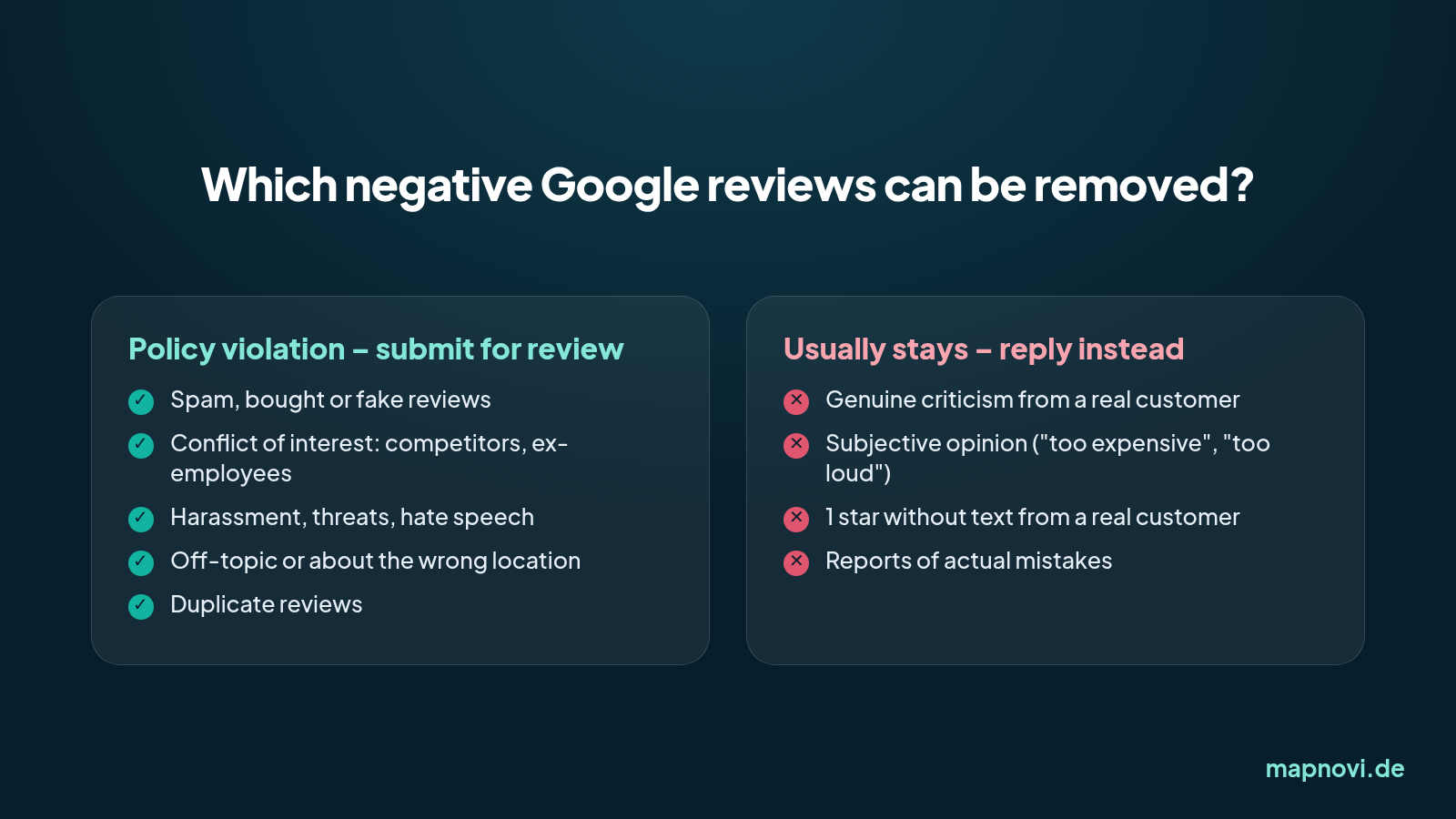
- Legitimate criticism. A real customer, a real mistake: long wait, cold food, unfriendly tone. Unpleasant but valuable – and with the right reply often a net gain for your profile.
- Unfair but permissible criticism. A real customer who exaggerates, had unrealistic expectations or simply disagrees ("too expensive"). Annoying, but an opinion – and it stays.
- Policy violations. Reviews by competitors or former employees, by people who were never customers, harassment, threats, spam, reviews about the wrong location or duplicate reviews. These violate Google's policies and can be removed.
Reply within 48 hours – here's how

Your reply is read not only by the person who reviewed you, but by everyone who opens your profile later. So write for tomorrow's readers, not for today's argument. A good reply to a negative review has four parts:
- Thanks and regret – without admitting fault when the facts are unclear: "Thank you for your feedback. We are sorry your visit did not go the way you expected."
- A specific reference that shows you read it: "The wait on Saturday evening was indeed longer than usual."
- What you are doing about it: "We have since capped Saturday reservations."
- An offer to resolve it privately: "Feel free to contact me personally at …"
Three to five sentences are enough. Only people who justify themselves write more – and that is exactly what reads worst.
What you must never do
- Argue in public. Every reader imagines being treated the same way.
- Disclose customer data. "You were here on 12 March and didn't pay" breaches data protection – and Google's policies for replies.
- Threaten legal action. Never in the public reply. For actual legal violations (false statements of fact, defamation) the route via Google or a lawyer is the right one – but quietly.
- Buy reviews to "bury" it. Bought reviews violate the policies themselves. Google removes them, and at worst the whole profile loses credibility.
- Ignore the review. An unanswered 1-star review reads like an admission.
How to recognise a policy violation
Google publishes its review policies. In practice these questions decide:
- Was the person a customer? No appointment, no invoice, no contact – then the review is very likely a violation (spam or conflict of interest).
- Is there a conflict of interest? Competitors, former employees, parties to a legal dispute.
- Is the content permitted? Harassment, threats, discrimination, sexual content or third parties' personal data get removed.
- Does the review match your business? Reviews about another location, another company or with no relation to the business are "off-topic".
- Is it a duplicate? The same person, several accounts, or several reviews for the same incident.
If any of these applies, submitting is worthwhile. The justification matters: Google checks against its policies, not against whether you like the review.
How Google's review process works
You submit the review with the violation for review; Google checks and decides. That takes anywhere from a few days to several weeks, and nobody can guarantee a removal – neither can we. What improves the odds:
- a precise match to the relevant policy instead of a general complaint,
- evidence where possible (no customer on record, a link to a competitor, identical texts),
- patience: after a rejection, a new, better-reasoned submission is possible.
You select the review, Google checks and decides. With Mapnovi you only pay if the review is actually removed – submitting is free.
Enter your location now and see which of your negative reviews qualify for a review.
And then: learn from the criticism
If the same complaint keeps coming back, the review is not the problem but the hint. Once a month, collect negative reviews in a list sorted by topic. Three times "long wait" is a staffing issue, three times "nobody answers the phone" is a process issue. Businesses that take this seriously need this guide far less often a year later – and have laid the foundation to improve their rating on Google Maps for good.
Conclusion
Negative Google reviews are no reason to panic, but a reason to act: classify, reply calmly within 48 hours, submit violations for review and fix recurring criticism in the business. Keep to that order and today's annoyance becomes tomorrow's customer trust.
Cover photo: tumisu, CC0